
Search
The film and television encyclopedia
Explore the encyclopedia
7417 results
Works shown : 2761–2784 / 7378.
Explore data for this selection
The selection in perspective
Works shown here by decade. This describes this catalogue, not world production or film popularity. Series use their first broadcast year.
- 1910–19197 works
- 1920–192936 works
- 1930–193945 works
- 1940–194967 works
- 1950–195988 works
- 1960–1969102 works
- 1970–1979344 works
- 1980–1989893 works
- 1990–1999961 works
- 2000–20091334 works
- 2010–20191924 works
- 2020–20291577 works
- Shortest
- 1 minREFUND
- Median runtime
- 95 min4146 documented films
- Longest
- 5220 minThe Cure for Insomnia
Calculated from cited-edition runtimes, including approximate values; series and unknown runtimes excluded. The median divides films into two halves by runtime. Decade links open the full catalogue.
How much time for a film?
Each documented film is counted once in a range. Counts and bars describe only films in this selection with a known runtime.
- 100 min or less
2552 / 4146 2552 - 101–139 min
1433 / 4146 1433 - 140–179 min
132 / 4146 132 - 180 min or more
29 / 4146 29
Runtimes refer to cited editions and may be approximate. Allow separately for breaks and discussion. Links below open the full catalogue filtered by runtime.
The Science of Sleep
Michel Gondry
Film from 2006. Directed by Michel Gondry.
Prisoner of Paradise
Malcolm Clarke
Film from 2002. Directed by Malcolm Clarke.
Children of the Corn III: Urban Harvest
James Hickox
Film from 1995. Directed by James Hickox.
A Simple Plan
Sam Raimi
Film from 1998. Directed by Sam Raimi.
Blink
Michael Apted
Film from 1994. Directed by Michael Apted.
Sometimes They Come Back... Again
Adam Grossman
Film from 1996. Directed by Adam Grossman.
The Son's Room
Nanni Moretti
Film from 2001. Directed by Nanni Moretti.
Losin' It
Curtis Hanson
Film from 1983. Directed by Curtis Hanson.
Once Bitten
Howard Storm
Film from 1985. Directed by Howard Storm.
Dennis the Menace
Nick Castle
Film from 1993. Directed by Nick Castle.
Welcome to Collinwood
Joe Russo / Anthony Russo
Film from 2002. Directed by Joe Russo / Anthony Russo.
La liceale nella classe dei ripetenti
Mariano Laurenti
Film from 1978. Directed by Mariano Laurenti.
Johnson Family Vacation
Christopher Erskin
Film from 2004. Directed by Christopher Erskin.
Assassin(s)
Mathieu Kassovitz
Film from 1997. Directed by Mathieu Kassovitz.
My New Partner
Claude Zidi
Film from 1984. Directed by Claude Zidi.
Clean Slate
Mick Jackson
Film from 1994. Directed by Mick Jackson.
The Crimson Rivers
Mathieu Kassovitz
Film from 2000. Directed by Mathieu Kassovitz.
De vrais mensonges
Pierre Salvadori
Film from 2010. Directed by Pierre Salvadori.
Rude Awakening
Aaron Russo / David Greenwalt
Film from 1989. Directed by Aaron Russo / David Greenwalt.
Lost Souls
Janusz Kamiński
Film from 2000. Directed by Janusz Kamiński.
Snow Dogs
Brian Levant
Film from 2002. Directed by Brian Levant.
Cemetery Man
Michele Soavi
Film from 1994. Directed by Michele Soavi.
Remember Me, My Love
Gabriele Muccino
Film from 2003. Directed by Gabriele Muccino.
The Adventures of Huck Finn
Stephen Sommers
Film from 1993. Directed by Stephen Sommers.
Practical guides
 01
Choose a streaming subscription
Choose a subscription by starting with the films and series you want to watch, then check their inclusion in your local plan. Compare devices, advertising, audio tracks and total…
Read guide ↗ 02
Understand 4K, HDR and picture quality
Resolution, HDR and compression quality describe different aspects of an image. Before changing your plan or display, check the source, title, playback settings and compatibility…
Read guide ↗ 03
Prepare offline viewing
Offline viewing requires an app that allows downloading your chosen title. Check device support, free storage and expiry, then test playback without a network before leaving.
Read guide ↗ 04
Analyse a film without losing enjoyment
To analyse a film, start with an observable detail: a position in the frame, a sound or a cut. Describe it before interpreting it, then compare it with another moment in the film.
Read guide ↗ 05
Start a series and avoid spoilers
Before starting a series, identify its starting point and episode order, then check the seasons offered by your service. Avoid spoilers by reading practical information without…
Read guide ↗ 06
Rental, purchase or subscription: which to choose?
Rental suits a specific screening; compare subscriptions using titles actually included and months used. For a digital purchase, check access terms: it does not necessarily…
Read guide ↗ 07
Watch a documentary critically
A documentary presents a viewpoint through its sources, framing and editing. Separate what is filmed, what is claimed and what evidence supports it, rather than treating an…
Read guide ↗ 08
Prepare a home film screening
To prepare a home screening, check the title, runtime, tracks and playback on your chosen device. Allow time for setup, breaks and discussion, then test sound and picture before…
Read guide ↗ 09
Live TV, catch-up and FAST channels
Live TV follows a schedule, while catch-up lets you choose a programme after broadcast within its access window. FAST channels are linear and ad-funded; check any on-demand…
Read guide ↗ 10
Manage renewals and cancellations
To cancel a subscription, first identify the service, store or operator billing you. Follow its procedure and keep confirmation and the access end date; deleting the app does not…
Read guide ↗ 11
Audio description and accessible subtitles
Audio description describes story-relevant visual details; accessible captions can identify voices and sounds. Check these options for the exact title, language and device, then…
Read guide ↗ 12
Cuts, restorations and editions: choose a version
To choose an edition, compare cut, runtime, framing, language and restoration source. One title can cover several versions: higher resolution alone does not establish that they…
Read guide ↗ 13
Drawn animation and stop-motion: seeing materials
To watch animation closely, observe how material, drawing or volume changes between images. Compare movement, texture and rhythm without reducing techniques to a contrast between…
Read guide ↗ 14
Watch a black-and-white film
Watching black-and-white cinema means following contrast, textures and the separation of planes through light. Describe a bright area and a dark area before assigning symbolic…
Read guide ↗ 15
Picture formats: preserve the frame
To preserve a film’s framing, respect its aspect ratio and avoid zoom settings that crop the edges. Black bars can be normal: compare the edition’s ratio with your screen’s ratio.
Read guide ↗ 16
Listen to a film: voices, music and effects
To listen closely to a film, separate voices, ambience, effects and music, then notice their entrances and silences. Ask what a sound suggests beyond the frame and who can hear it…
Read guide ↗ 17
Choose a film for your available time
To choose a film for your available time, subtract breaks and discussion first, then compare the edition’s runtime. Approximate runtimes need a margin; check series timing per…
Read guide ↗ 18
Discuss a film after viewing
A film discussion benefits from starting with a specific scene rather than an overall verdict. Separate observed detail, personal response and interpretation, then listen to other…
Read guide ↗ 19
Understand editing without jargon
To understand editing, observe what changes between two shots: place, time, movement, gaze or sound. Describe the transition and the information it adds or withholds before…
Read guide ↗ 20
Fiction, documentary and re-enactment
Fiction, documentary and reconstruction differ in their relationship to events and how they present sources. Identify who films, who narrates and what is reenacted; a realistic…
Read guide ↗ 21
Explore world cinema
To explore world cinema, start with a work and its production references, then compare specific forms and contexts. Production country, language and story setting are different…
Read guide ↗Platforms

Cinema paths
Images, stories and evidence
Compare a sensory essay with an investigation through two documentaries. Their goals differ: notice what images suggest and what testimony allows you to check.
Serial, limited series or anthology?
Choose a form to suit your pace. A continuous story builds relationships over time; a limited series offers a bounded whole; an anthology renews its stories. Episode length alone does not predict the experience.

Masks, roles and identities
Persona explores speech and silence, All About Eve social roles, Severance an organised separation of experience. Compare how you come to know a character: speech, another person’s gaze or gestures made away from supervision.
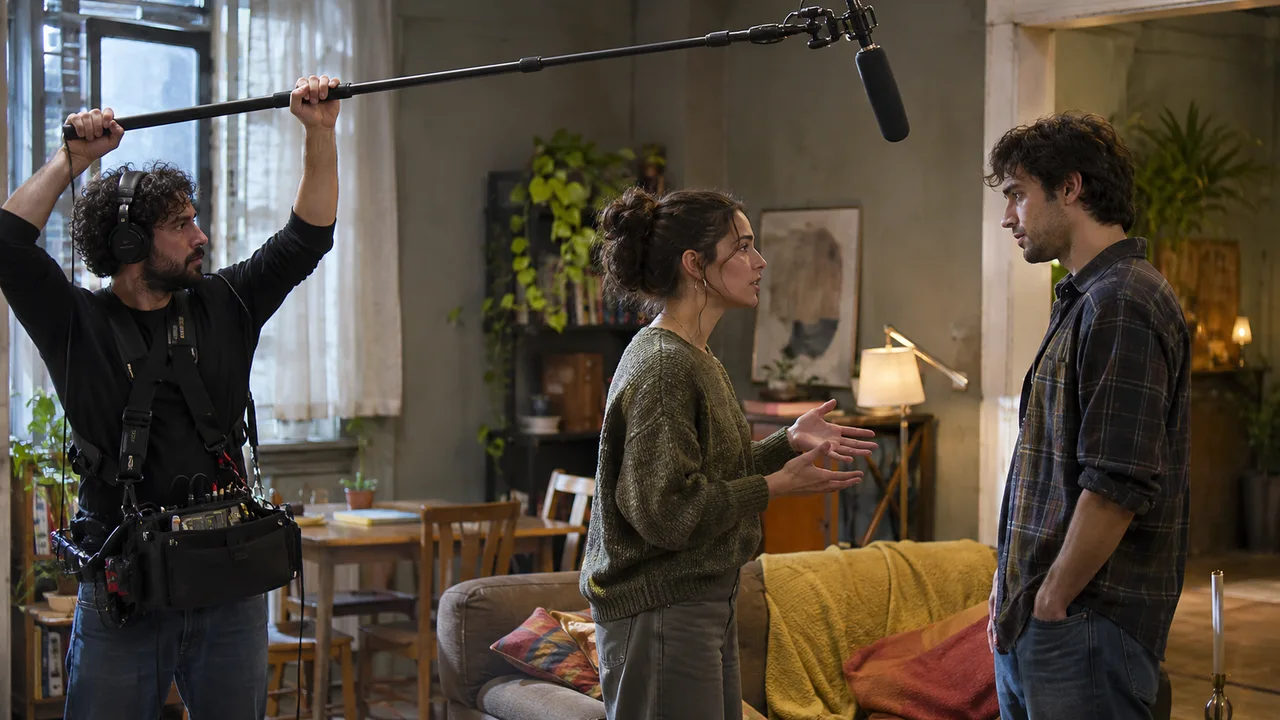
The city seen and heard
Compare crowds and sound in PlayTime, Do the Right Thing and Koyaanisqatsi. A street can host exchange, direct bodies or create rhythms. Choose a scene making each city recognisable without consulting a map.

Listen beyond the frame
A sound can suggest a place, an arrival or a revised impression. A Man Escaped, Night of the Living Dead and The Piano offer different uses; unseen sound is not always threatening.
Reading film posters
See how format and release market shape the layout. Grand Hotel uses a tall poster, Duck Soup spreads its design horizontally, and the narrow To Have and Have Not insert stacks its elements. Roland Coudon’s Tarzan bears a French title. Each film entry identifies the surviving poster and its source.
World cinema
Japan
From Seven Samurai’s group to Tokyo Story’s family and Miyazaki’s animated worlds: discover Japanese filmmakers through distinct forms rather than a single national style.
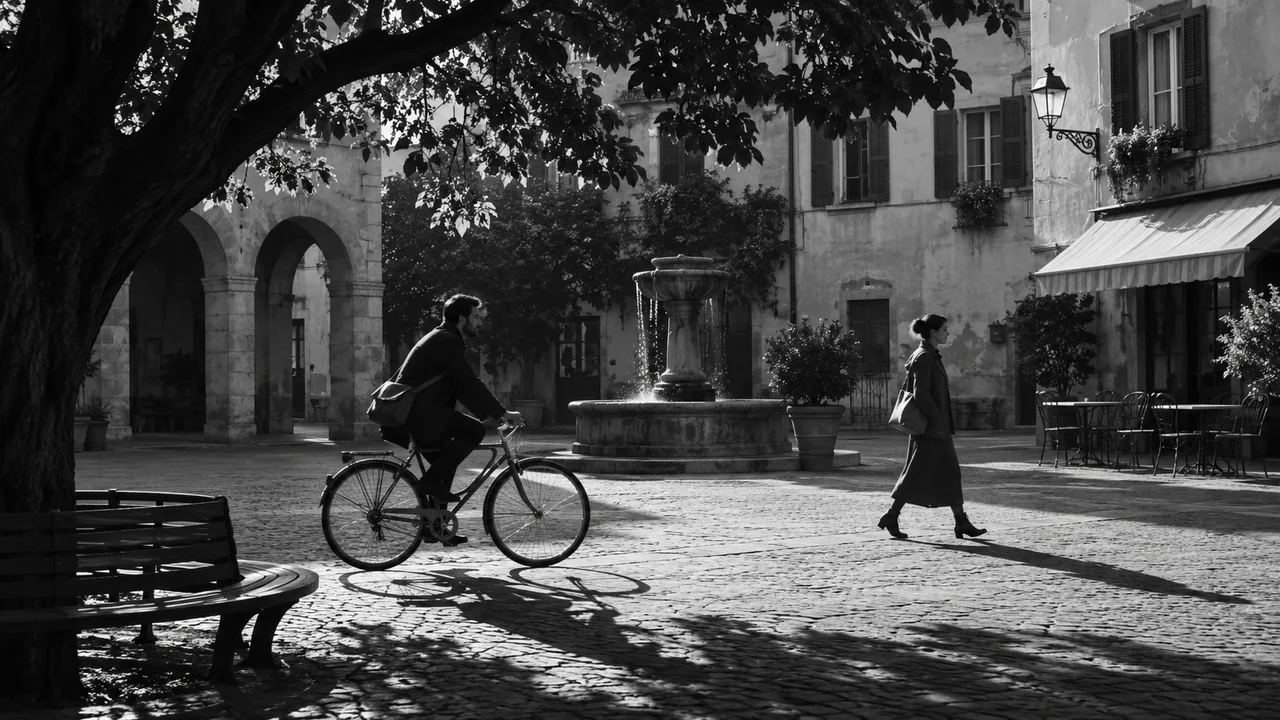
Italy
Bicycle Thieves explores everyday life and the city; The Battle of Algiers, listed under Italy and Algeria, asks different questions about re-enactment and historical viewpoints.

India
Pather Panchali opens a path through childhood, listening and family life. This Bengali starting point alone does not represent Indian cinema’s diversity of languages and forms.

Senegal
Touki bouki offers discovery through movement, departure and sonic breaks. This dossier follows one work and filmmaker rather than claiming to summarise Senegalese cinema.
United States
This selection gathers works whose catalogue sources list the United States, spanning comedy, documentary, animation and drama. It is not a complete account of American cinema. Reference country and story setting differ: Before Sunrise takes place in Vienna while Criterion lists the United States.
United Kingdom
Catalogue references connect 2001: A Space Odyssey and The Red Shoes to the United Kingdom. The former also lists the United States; co-productions can appear in several selections. Two works do not summarise a national tradition, but offer a contrast between space journey and dance performance.
Sweden
Persona, Wild Strawberries and The Seventh Seal are the documented Swedish works here. All are directed by Ingmar Bergman; the path compares forms within one body of work, not all Swedish cinema.
Glossary
- 4K UHD
- Common consumer resolution of 3840 × 2160 pixels. Quality also depends on compression and source.
- SDH / CC
- Captions including sound information and sometimes speaker identification. Conventions vary by service and language. During a trial, choose a passage with several speakers and an off-screen sound. Check what the captions actually convey beyond their presence in the menu.
- Off-screen space
- What lies beyond the visible frame but may be suggested by a look, sound or story.
- Projection frame rate
- Number of frames shown per second, distinct from picture shape. With an unchanged frame count, moving from 24 to 25 frames per second reduces runtime to 24/25 of its original value. A conversion can also preserve runtime, so this calculation does not prove that an edition runs faster.