A documentary presents a viewpoint through its sources, framing and editing. Separate what is filmed, what is claimed and what evidence supports it, rather than treating an isolated image as a complete explanation.
Identify the approach: investigation, portrait, archive, observation or visual essay. Documentary is not automatically a full record. Notice who speaks, who is absent and how reconstructions or archive images are identified.
02 Check claims
Separate checkable claims from impressions produced by editing. Record a date, number or quotation only if its source and context can be found. For current issues compare recent documents; film date does not date every image.
03 Editing and evidence
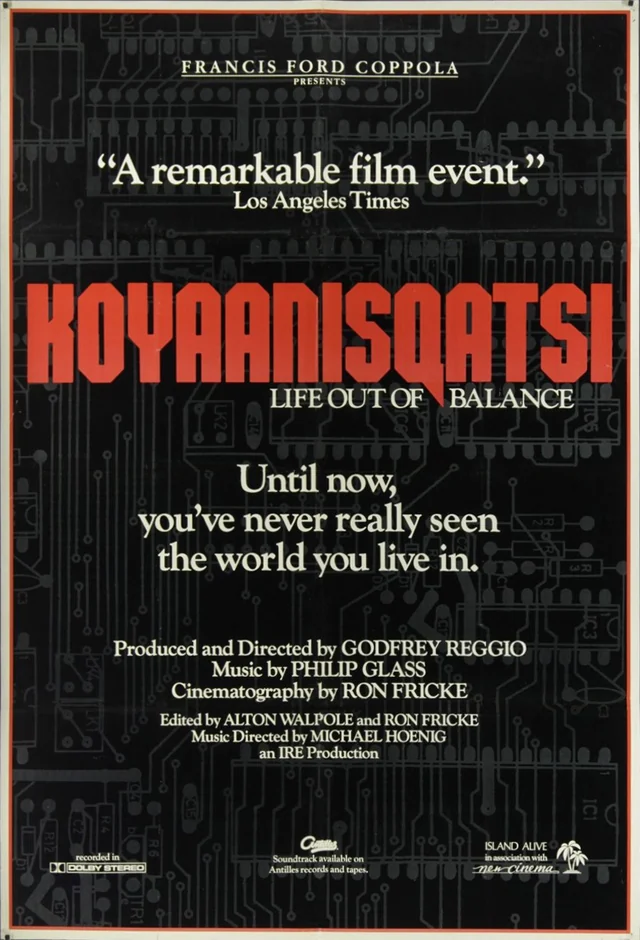
Use Koyaanisqatsi as an exercise: describe a sequence, then the idea emerging from its relation to the next. This separates observation from interpretation while preserving aesthetic impact. For investigative films consult the authors’ references.
Frequently asked questions
Is re-enactment archival footage?
No: it presents a construction after the event. Check what independent testimony or documents establish.
A documentary scene can draw power from both an encounter and its editing. Separate what someone recounts, what an image documents and what the film juxtaposes. This is a reading method, not a verdict on truth.
Three pointers for your next screening
Pointer
Observe
Explore further
Testimony
Who speaks, about which experience, and from what point in time?
Separate a remembered event from the present filming. Faces and silences can matter as much as words.
An archive
Does the film identify the origin, date and context of the image or sound?
An old image does not alone prove everything a commentary says. Examine their precise relationship.
A juxtaposition
Do adjacent shots seem to show the same place or period? What confirms it?
Editing can suggest comparison without establishing real continuity. State your hypothesis and leave missing information open.
After viewing, choose one claim to check against the film’s cited sources. Keep that check separate from your response to its form and emotional impact.
Put the advice into practice
Works cited for viewing exercises. Their presence does not imply availability on a service.
A documentary may combine interviews, archives, reenactments and illustrative footage. Record the claim, its timing and the accompanying image. Voice-over can interpret a shot without proving the stated place, date or event. Authentic footage may illustrate a different subject.
The BFI explains the identifiers and records assigned to acquired material. Start with the credits to find title, identifier, period and provenance in a catalogue. A shared still may have lost its caption. For disputed points, compare sources and separate observation, testimony and editing interpretation.
If the credits name only the collection, record the timestamp in the documentary and a visible clue, such as a sign or location. The BFI says its catalogue includes alternative titles and release or broadcast dates. Use those fields to narrow your search, then compare the resulting record with the shot before accepting the identification.
Try the reasoning
Authentic footage accompanies narration about another place. What evidence is missing?
The documented link between image, place and claim.