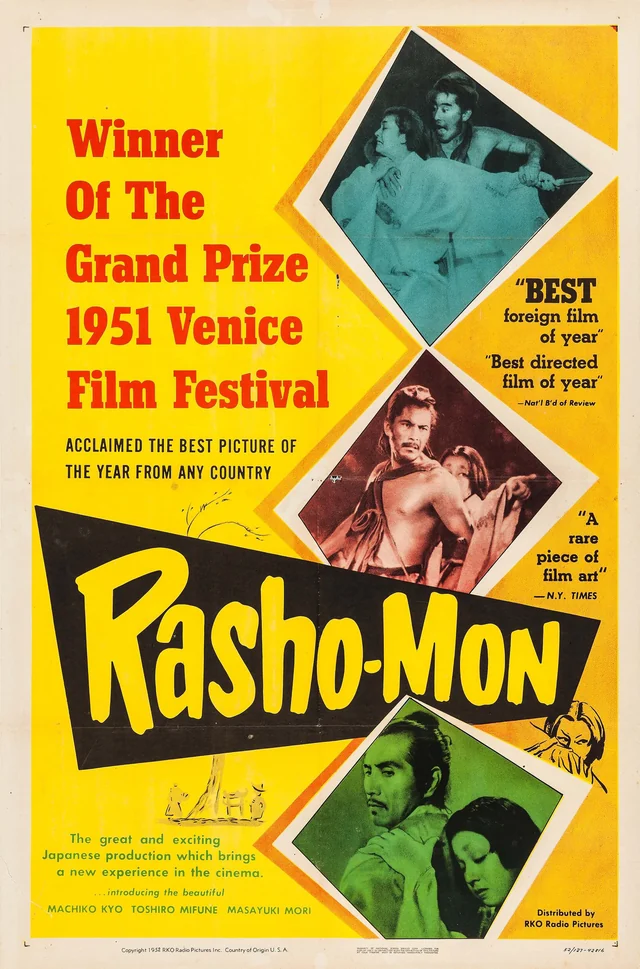
Several witnesses give conflicting accounts of a crime in a forest.
What to watch for
Track changes in gestures, positions and reactions across accounts. Distinguish the film’s presentation from a witness’s account. Afterwards, ask which version persuaded you and which clues you used.
Behind picture and sound
- Screenplay
- Akira Kurosawa, Shinobu Hashimoto
- Cinematography
- Kazuo Miyagawa
- Music
- Fumio Hayasaka
Rashomon: testimony is not independent proof
Editorial reading · WORLD MOVIES GUIDE ·
These prompts offer interpretation and viewing exercises without revealing the ending. They are distinct from the sourced edition facts in the entry.
Separate the levels of narration
During the screening, distinguish the narrator, the images associated with their account and your interpretation. A clear, detailed image can feel certain without being independent confirmation. This distinction lets you follow Rashomon without reducing it to a puzzle with a correct solution. Attend to a version while remembering who offers it. Avoid explanatory summaries before viewing: they may impose an answer to questions the film invites you to formulate.
Observe what changes
After viewing, choose a gesture or attitude appearing in several accounts. Describe differences in initiative, hesitation, posture or another character’s response. How do they change your judgment? Who seems to act, endure or protect their dignity? This is a viewing proposal, not a psychological diagnosis. Acknowledge differing memories: comparing viewers’ recollections already reveals how selecting details shapes interpretation.
Compare with Close-up
Close-up offers another route into narration, staging and credibility. Do not automatically label the first film misleading fiction and the second certain documentation. Ask what status you give to speech, a re-enacted scene or a filmed person. For a short exchange, distinguish something you believe you saw from a conclusion you drew. This makes disagreement precise without forcing a group verdict.
After viewing: a question to discuss
Which detail separates a witness’s account from what the image makes you believe? Choose two accounts and separate their claims from what you observe in the images. Note one detail supporting your reading and another leaving it open.
Cinema paths
World cinema
Before watching
Check availability in your country, audio, subtitles and local age rating. This entry does not promise catalogue availability. Editions may differ: consult the source for technical details.
Reference checked :