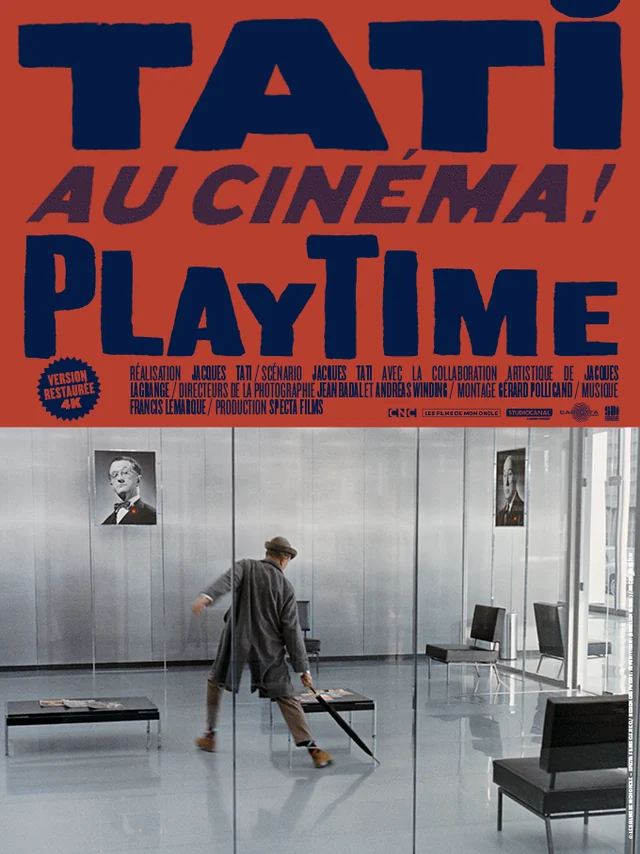
Monsieur Hulot crosses a Paris of glass and offices where encounters and objects create a comedy of modernity.
What to watch for
Use a screen that keeps details legible and disable edge-cropping zoom. Let your eye wander: a gag need not sit at the centre. On a repeat viewing, follow a supporting character or sound rather than only Hulot.
Behind picture and sound
- Screenplay
- Jacques Tati, Jacques Lagrange
- Cinematography
- Jean Badal, Andréas Winding
- Music
- James Campbell, Francis Lemarque
- Editing
- Gérard Pollicand

PlayTime: learning where to look
Editorial reading · WORLD MOVIES GUIDE ·
These prompts offer interpretation and viewing exercises without revealing the ending. They are distinct from the sourced edition facts in the entry.
A frame that leaves choices open
In a comedy centred on a hero, the cuts often guide your eye towards the person preparing the gag. With PlayTime, try suspending that habit: watch the edges and the people waiting or crossing the background. A secondary action can become your main interest. You are no longer only following Hulot; you build a route through a shared space. Accept missing details on a first viewing. A second look need not mean that the first was incomplete.
Listening to surfaces
Choose a short passage in an office or circulation space. Notice a footstep, door or object sound, then find its cause in the image. Does it make the place practical, solemn or absurdly complicated? Windows and reflections pose a similar question: can a visible space really be entered? Our reading links seeing without entering to hearing without immediately identifying. Rather than making every prop a symbol, first describe its concrete effect on movement.
A comparison to extend the screening
With Cléo from 5 to 7, compare two ways of exploring the city. Who organises your route: someone whose waiting you share, or encounters within an open frame? The useful question is how form changes attention, rather than which city looks most realistic. In discussion, each viewer can name a detail others missed and explain what guided their eye.
PlayTime: separate filming and edition
The 70 mm format describes Tati’s filming choice; Criterion describes a particular digital edition. Do not transfer its specifications automatically to another screening or stream.
| Reference | What the source documents | Try during viewing |
|---|---|---|
| Production | Tati shot PlayTime on 70 mm to use the depth and breadth of the frame. | In a movement scene, follow two simultaneous actions in different parts of the image. |
| Cited edition | Criterion lists a 4K digital restoration and 3.0 surround track for its UHD edition. | Before comparing two viewings, note the actual medium, screen size and sound setup. |
After viewing: a question to discuss
Which background gesture draws your eye away from the main action? Describe one area of the frame before following a character. Then compare what you noticed with what your attention left out of the description.
Cinema paths
World cinema
Before watching
Check availability in your country, audio, subtitles and local age rating. This entry does not promise catalogue availability. Editions may differ: consult the source for technical details.
Reference checked :