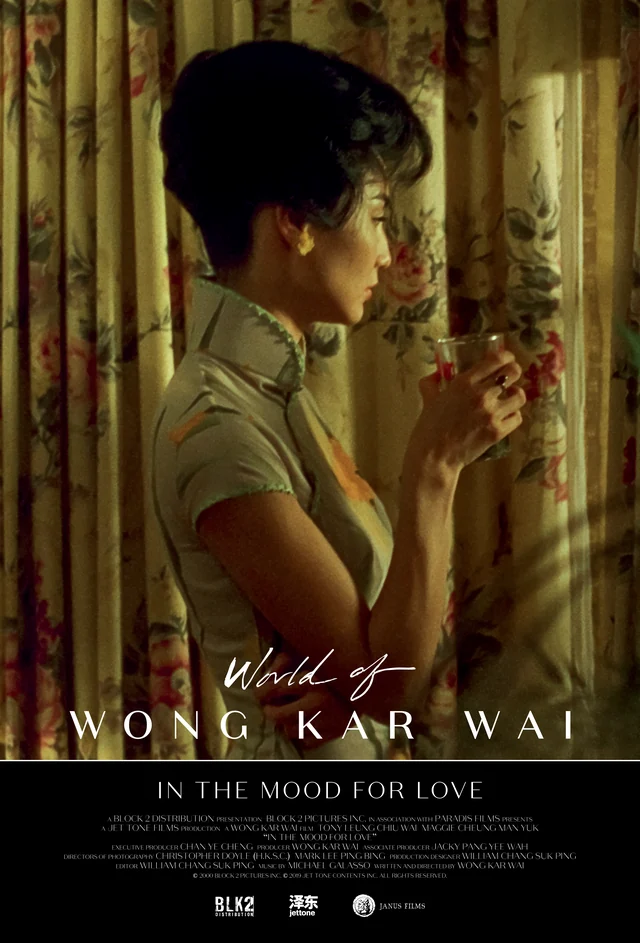
Two neighbours brought together by their spouses’ infidelity explore a restrained connection.
What to watch for
Corridors, framing and recurring music give shape to what remains unsaid. Pay attention to silence rather than expecting plot twists. Afterwards, compare its colour and framing with The Grand Budapest Hotel.
Behind picture and sound
- Screenplay
- Wong Kar Wai
- Cinematography
- Christopher Doyle, Mark Lee Ping Bing
- Music
- Michael Galasso
- Editing
- William Chang Suk Ping

In the Mood for Love: feeling through repetition
Editorial reading · WORLD MOVIES GUIDE ·
These prompts offer interpretation and viewing exercises without revealing the ending. They are distinct from the sourced edition facts in the entry.
Watch passages rather than revelations
For a first viewing, notice passages: corridors, stairs, thresholds and everyday routes. A narrow place can make an encounter almost unavoidable while leaving little room for direct speech. Our reading starts from this spatial tension. Before asking what people feel, watch how they stand, wait or cross paths. Restraint becomes an experience created by staging, rather than merely a trait explained through dialogue.
Repetition is not immobility
When a route, music or situation seems to return, seek a precise difference. Who looks? How long is the wait? What detail signals a new closeness or distance? Do not count every occurrence on a first viewing; remember two that affected you. Comparing them afterwards lets you discuss rhythm without equating slowness with no development. Repetition can measure a tiny change even when the plot does not name it.
Compare two uses of space
With PlayTime, compare the space given to the viewer. A dense frame may invite you to move between actions; a narrow passage may hold your attention on one relationship. Neither form is superior. Discussion becomes useful when an impression is linked to a visible choice: a foreground obstacle, distance between people or shot length. Choose a scene from each film and describe what you could watch freely and what the framing made you wait for.
After viewing: a question to discuss
Does a recurring place change meaning between encounters? Compare light, distance and silence.
Before watching
Check availability in your country, audio, subtitles and local age rating. This entry does not promise catalogue availability. Editions may differ: consult the source for technical details.
Reference checked :